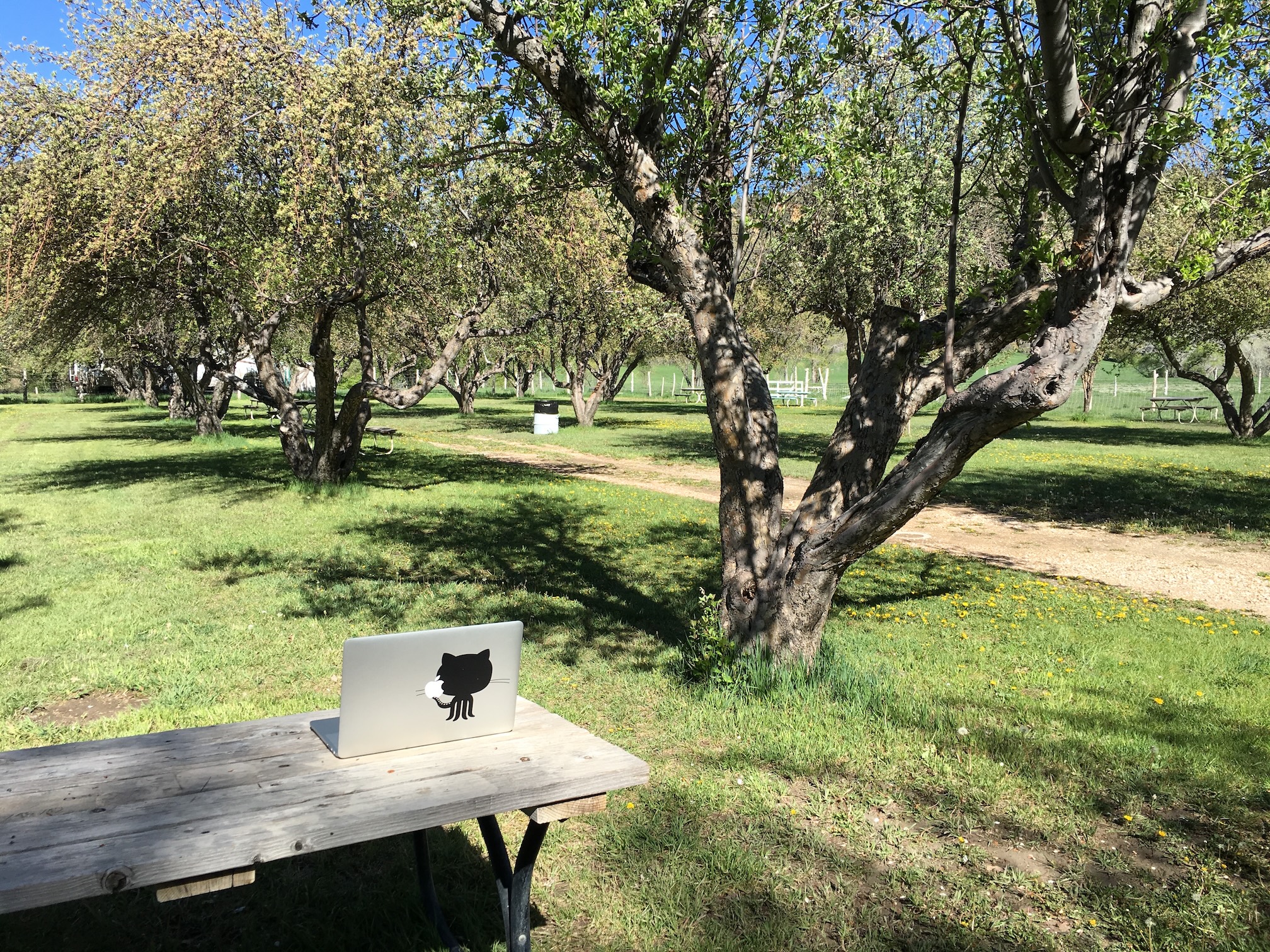
The picnic bench at Mt Carmel Junction, Utah, where JOSS was launched from – May 2016.
Ten years ago this month, I announced a small experiment on this blog: a developer-friendly journal for research software, built around GitHub, with a review process that treated software as a first-class research output rather than an afterthought. It wasn’t clear it would work, but it was a fun project to hack on as my family and I spent a year traveling around the US.
Ten years is a long time in a volunteer role 😅, and after a decade of running JOSS, I’ve decided it’s time to step down as Editor-in-Chief. We’re now looking for the next EiC, and the transition will happen through the end of 2026.
I want to use this post to say a few things about how we got here, and where I think JOSS goes next.
An experiment that worked
JOSS started as an experiment, and it has turned into something genuinely special. The original design borrowed heavily from things I’d been thinking about and working on for years: the ChatOps-driven automation I’d seen up close at GitHub, and my own frustrations writing software in academia and watching that work often go unnoticed or be misunderstood. At the same time, I was working at GitHub as their ‘academic liaison’, which meant a long series of conversations with people in the research software community who had been wrestling with the same problems. None of the ideas were really mine – and of course rOpenSci were already doing great community-based reviews of research software. JOSS was an attempt to put the pieces together in one place and see what happened.
What happened, it turns out, is that a lot of people showed up. More than 3,500 papers later, JOSS is still here, still free to publish in and free to read, still running on a few dollars per paper, and still, quite remarkably I think, sustained entirely by volunteer effort. Over the past decade, more than 11,000 authors and 4,200 reviewers have been part of JOSS, and today the journal is run by an amazing editorial team of over 100 active editors led by a small but mighty group of AEiCs who keep the whole thing moving.
I’m enormously proud of what we’ve built together, but the “we” really matters here. JOSS exists because a community of editors, reviewers, authors, and advisors decided it was worth their time. I owe a particular debt to the founding editorial team – Lorena A. Barba, Abigail Cabunoc Mayes, Kathryn Huff, Daniel S. Katz, Kevin M. Moerman, Kyle Niemeyer, Karthik Ram, Tracy Teal, and Jake Vanderplas – who helped shape JOSS in those early conversations and took a chance on a new experimental journal. For me, JOSS is a standing example of what’s possible when a group of people quietly decide to work together to provide a community service.
A good moment for new leadership
JOSS is in good shape. The operating model is sound, we’ve been running at a small number of dollars per paper for years, and we have a diamond open-access funding model that gives us many years of runway under current conditions. The editorial team is strong. The infrastructure is solid, and I’ll continue to look after it as the Open Journals tech lead.
It’s also a genuinely interesting moment for research software. Generative AI changes a lot of assumptions about what software is, how it’s produced, and what’s worth reviewing. We’ve thought hard about this and recently updated JOSS’ scope to focus on the things only humans contribute: problem framing, design judgment, durable abstractions, and the open collaborative practices that make software trustworthy. I think the new scope sets us up well, and the next EiC will be in the front seat for helping the community navigate what comes next.
The EiC role is an important one, and to do it well it needs someone’s dedicated attention. After ten years, I think the right thing for JOSS is for that attention to come from someone new, who wants to make this their focus for the next chapter. I’m not going anywhere: I’ll continue as the Open Journals tech lead, keeping editorialbot running, and I plan to stay active as a JOSS editor. But the editorial leadership is ready to be passed on.
If you’re interested, or you know someone who would be a great fit, the call is here.
Thank you to everyone who has been part of JOSS over the past decade. It has been one of the great privileges of my career.